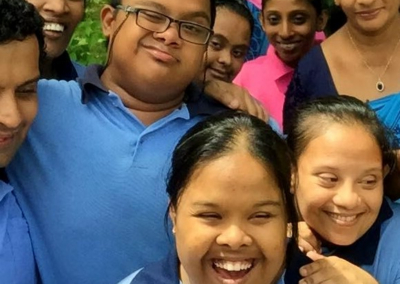
The Daya Mina Centre in Colombo (Sri Lanka) provides life skills and vocational training to young people with intellectual disabilities. The project aims to support 50 to 60 young people in developing essential life skills. This enables them to participate more actively in society, including in the areas of employment, sports, and social activities.
It is expected that around 50% of the participants will develop sufficient skills to progress to some form of vocational education or sheltered employment. At the same time, the Daya Mina Centre is supported in strengthening its institutional capacity and long-term sustainability. Of the annual costs of €8,500, €4,000 in external funding is required for the purchase of training equipment and materials.
Amount required: € 4.000
Project information
The situation
In Sri Lanka, people with intellectual disabilities are often among the least accepted members of society. They are frequently considered incurable, and many believe that there is little prospect for change or progress.
The Daya Mina Centre in Colombo supports young people who are unable to function adequately, independently, or appropriately due to an intellectual disability or learning difficulties. They require specialised training and education to enable them to take their rightful place in society and make a meaningful contribution.
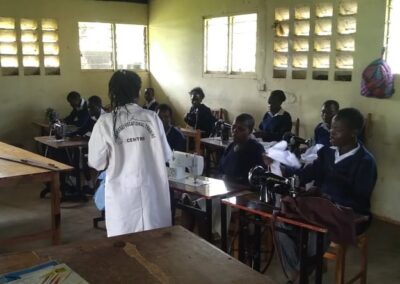
The centre accommodates between 50 and 60 young people, who are supported and guided by 12 staff members and several local and international volunteers.
The importance of the project
In Sri Lanka, the availability of services for young people with intellectual disabilities is limited. Existing initiatives often focus on those with physical disabilities or are restricted to basic care and support. The development of vocational skills is frequently overlooked, even though it offers a pathway to (partial) economic independence.
By combining life skills training with practical, production-oriented activities, the Daya Mina Centre provides an integrated approach in which participants gain work experience and build their self-confidence.
The implementing organisation
Daya Mina has been working with this group of young people for more than 35 years.
The Daya Mina Centre in Sri Lanka was founded in 1989 by the Sisters of Charity of Jesus and Mary (SCJM). Since 1998, the centre has also been supported by the Daya Mina Foundation in the Netherlands, which raises funds for infrastructure and equipment such as buildings and transport for the centre in Sri Lanka.
The vision of Daya Mina is that everyone should have the opportunity to live a fulfilling life, regardless of race, caste, or belief.
Read more about Daya Mina:
The envisaged project results
The project provides annual life skills training for 50–60 young people with intellectual disabilities. It is expected that around 50% of the participants will develop sufficient skills to progress to some form of vocational education or sheltered employment.
In addition, the project aims for the following outcomes:
- Participants demonstrably improve their independence and social skills;
- Participants develop practical vocational skills;
- The centre further strengthens its capacity and quality of service delivery.
Experience shows that participants are motivated and capable of development. They produce tangible outputs and achievements, demonstrating that—despite their disabilities—they possess talents and potential for growth.
Chance of sustainability
The project contributes to sustainable development at both the individual and institutional levels. Participants acquire skills that enable them to take a more active role in daily life and—where possible—in employment. Examples include independently doing groceries, performing household tasks, contributing to catering activities, supporting others, and participating in small-scale production or external workplaces.
In addition, the centre generates income through the sale of products made by the participants. These revenues are used to support the training activities and contribute to the financial sustainability of the centre.
At the same time, investments are made in strengthening institutional capacity, ensuring that the centre can continue to provide high-quality support in the long term.
Project costs
For the period 2026–2027, funding is requested for the implementation of activities in the areas of life skills and vocational training, as well as for support aimed at capacity building and sustainability.
The total annual budget amounts to €8,500. Of this, the Daya Mina Centre and the Daya Mina Foundation in the Netherlands jointly contribute €4,500. External funding is sought for the remaining €4,000. These funds will be used for the purchase of training equipment and materials essential for the implementation of the programme.
Dear visitor,
We are grateful that you are willing to support us with a donation!
Please fill in the fields below and push the button PAY to transfer the amount by iDeal.