
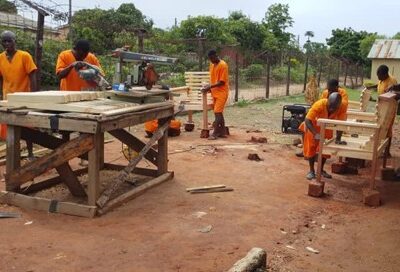
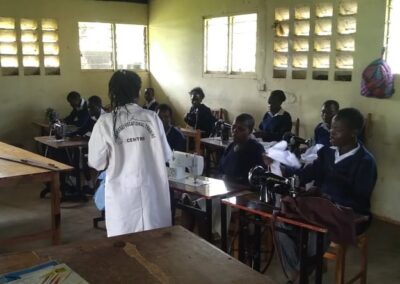
Prison Fellowship Society Zambia organizes vocational training in Ndola Prison to prepare inmates for reintegration into society. Since 2022, Prison Fellowship has also provided vocational training in Ndola’s townships to offer vulnerable unemployed youth new prospects and reduce their risk of involvement in criminal activities. Over a three-year period, 160 young people completed six-month courses in tailoring and computer skills, with financial support from the Van Doorn Foundation. The pilot yielded very positive results and is now being continued and expanded.
The expansion includes new courses in furniture making, plumbing, and computer hardware repair, for which there is strong interest among youth. For equipment and tools for the new courses and entrepreneurship training, €4,500 is required.
Amount required: € 4.500
Project information
The situation
During the copper mining boom of the 1960s and 1970s, Ndola became Zambia’s main commercial and industrial hub. Over the past two decades, however, the city has experienced economic decline, with business closures and rising unemployment. The townships of Mushili and Kawama are among the poorer areas, characterized by informal settlements, high unemployment, drug abuse, teenage marriages, and prostitution. Youth unemployment is five times higher than adult unemployment, largely due to a lack of relevant skills and entrepreneurship knowledge.
As a result, many young people struggle to access the labour market and remain trapped in poverty, increasing their vulnerability to risky and illegal activities.
The importance of the project
Approximately 86% of Zambia’s population lives in poverty, and young people form a significant share of the unemployed. Despite economic decline, new opportunities are emerging in sectors such as telecommunications, tourism, and agriculture, making targeted vocational training essential to enable youth to benefit from these developments.
Research in Mushili and Kawama shows higher poverty and school dropout rates than in other parts of Ndola. Youth unemployment increasingly leads to theft and prostitution, attracting other criminal activities. Churches have therefore established youth centres, where Prison Fellowship provides vocational training to help young people earn a living and reduce poverty and crime.
The implementing organisation
The Prison Fellowship Society of Zambia is a Christian organization founded in Ndola in 1984. It works to improve the well-being of prisoners, ex-prisoners, and their families and advocates for a fair and effective criminal justice system. A key component of its work is preparing prisoners for reintegration through vocational training.
Prison Fellowship organizes vocational training in Kansenshi Prison and community-based training in the Mushili and Kawama youth centres.
The envisaged project results
The youth centres in Mushili and Kawama provide classrooms for vocational training. Existing courses in tailoring and computer skills will be expanded with new courses in furniture making, plumbing, and computer hardware repair, based on youth preferences. In the first year, 35 young people will benefit, and all participants will also receive entrepreneurship training.
Participants will acquire skills to generate income through employment or small businesses. Ultimately, the project aims to reduce youth unemployment, poverty, and crime in Mushili and Kawama.
Chance of sustainability
Thirty-five disadvantaged youth will learn trades that enable them to earn sustainable livelihoods. The new courses will provide a long-term expansion of vocational training opportunities in the townships, where demand is high.
Experience from the pilot shows that the training programmes can partly finance themselves. Students pay only a symbolic contribution, while income is generated from the sale of products (e.g. clothing and furniture) and services (plumbing and computer maintenance). These revenues cover running costs, while external funding is needed only for major investments.
Project costs
The project duration is one year. The first three months will be used to set up the new courses, followed by six months of vocational training for 35 youth, and three months of entrepreneurship training and job placement or business start-up support.
Total project costs are ZMW 130,600. External funding of ZMW 99,100 (€ 4,500) is required for equipment and tools for the new courses and for entrepreneurship training

Dear visitor,
We are grateful that you are willing to support us with a donation!
Please fill in the fields below and push the button PAY to transfer the amount by iDeal.